
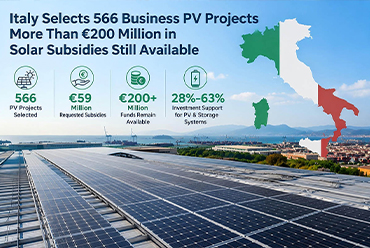
Italy's Ministry of Environment and Energy Security (MASE) recently announced the preliminary list of selected self-consumption photovoltaic (PV) projects for businesses in southern Italy. A total of 566 projects successfully advanced to the evaluation stage, with requested subsidies totaling approximately €59 million. However, given the program's total budget of €262 million, more than €200 million in funds remains unallocated. This subsidy program was launched in October 2025 under Ministerial Decree No. 424/2025. The original application deadline was March 3 of this year but was officially extended to July 3 to broaden participation among eligible enterprises and ensure full utilization of the allocated budget. Preliminary review results indicate that the largest funding request came from MI.LO. Srl, a company based in the Puglia region, with a project involving a total investment exceeding €30 million. Additionally, SGMImpianti Srl, a company from Sicily, achieved the highest overall score, performing best across the majority of evaluation criteria. Italy's Energy Services Manager (GSE) has now initiated the technical review phase. Projects will be evaluated based on their ranking, with a focus on verifying the completeness of documentation and compliance with tender requirements. Companies must submit any necessary supplementary information within 30 days. To qualify for this incentive program, PV systems must have a rated capacity between 10 kW and 1 MW, making them suitable for commercial and industrial rooftops, production facilities, and SME energy needs. Subsidy rates vary by company size and project type: standard PV projects can receive support covering 38%–58% of investment costs, while PV-thermal systems qualify for higher rates of 43%–63%. If a battery energy storage system is included, the storage component is eligible for investment support ranging from 28% to 48%. The number of applications in this round was relatively low compared to the available budget, meaning significant funds remain accessible to companies looking to reduce electricity costs through on-site renewable energy generation.
Read More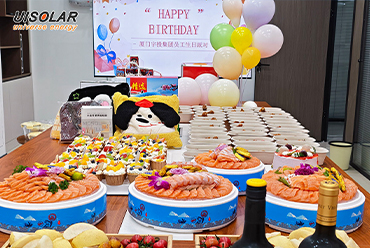
At UISOLAR, we engineer solutions that support Solar Panels across the globe. But behind every racking system stands an even stronger foundation: our people. This week, we paused to celebrate a team member's birthday. More Than Just a Cake A table. A cake with flickering candles. Colleagues trading technical talk for laughter and off-key singing. In that simple moment, we were reminded that UISOLAR is more than a team of engineers, sales experts, and logistics professionals — it is a community. Each person brings a unique spark to our shared mission, from R&D precision to global sales energy to the quiet dedication behind every shipment. Global Reach, Human Touch Our products travel far — from Xiamen to Europe, the Americas, and beyond — trusted by Solar Structure Installers, Distributors, and EPC firms worldwide. But our greatest export is not just hardware; it's the care we put into everything we do, starting with how we treat one another. At UISOLAR, we believe the same precision we apply to engineering should also apply to human connection. A team that celebrates together stays together — and delivers excellence together. Here's to Many More Sunrises To our birthday star: Thank you for being part of this journey. May your new year shine as brightly as the clean energy we bring to the world. And to our entire UISOLAR family — across every country and time zone — you are the reason we do what we do. Happy Birthday from all of us at UISOLAR. ☀️ — The UISOLAR Team
Read More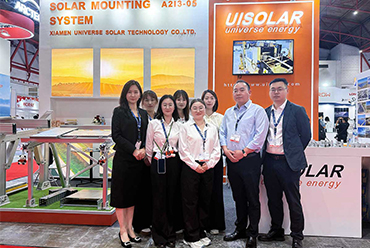
Jakarta, Indonesia – April 24, 2026 – XIAMEN UNIVERSE SOLAR TECHNOLOGY CO., LTD. (UISOLAR), a premier high-tech enterprise specializing in photovoltaic racking solutions, successfully concluded its participation in the Solartech Indonesia 2026. Held from April 22 to 24 at the JIExpo Kemayoran in Jakarta, the event is recognized as the ASEAN region’s largest trade exhibition for solar power and PV technologies. As Indonesia accelerates its commitment to achieving net-zero emissions by 2060, the country is unlocking over 3,200 GW of solar potential, making it one of the most critical renewable energy markets in the world. During the three-day exhibition, UISOLAR engaged with a dynamic audience of over 25,000 trade professionals, including EPCs, distributors, and installers from across the archipelago. Strategic Showcase of Mounting Expertise Founded in 2010 and based in Xiamen, UISOLAR is renowned for its dedication to innovation, stringent testing, and ease of installation. At Booth A213-05, the company captivated visitors by displaying its diverse portfolio of high-strength racking systems: · Versatile Rooftop Solutions: Including advanced systems for both pitched and flat roofs, specifically designed to withstand Indonesia's tropical climate and high humidity. · · Ground Mount & Solar Carports: Robust and customizable structures tailored for large-scale ground-mount projects and commercial infrastructures. · · Corrosion-Resistant Technology: Given the high temperature and humidity levels in Jakarta, UISOLAR highlighted its specialized anti-corrosion treatments and aluminum alloy materials that ensure long-term durability and structural stability in coastal environments. · Driving Energy Independence in ASEAN With the Indonesian government actively promoting large-scale solar deployment and local manufacturing, the demand for reliable, cost-effective, and easy-to-install racking systems is surging. UISOLAR’s presence at Solartech 2026 underscored the company’s role as a key partner in the region's energy transition, offering solutions that reduce installation time and maintenance costs. "Our technology is designed to empower local installers and EPCs. We don't just supply hardware; we provide certainty in harsh weather conditions," a representative from UISOLAR noted during the exhibition. "The response from the Indonesian market has been overwhelmingly positive, and we are excited to contribute to the nation's solar goals." About XIAMEN UNIVERSE SOLAR TECHNOLOGY CO., LTD. UISOLAR is a leading high-tech enterprise dedicated to providing world-class photovoltaic racking solutions. With a strong focus on environmental stewardship and product excellence, UISOLAR’s products are widely trusted by installers, distributors, and EPC firms worldwide, covering applications ranging from residential rooftops to utility-scale ground power plants. Media Contact: XIAMEN UNIVERSE SOLAR TECHNOLOGY CO., LTD. Website: www.uisolar.com Email: sales@uisolar.c...
Read More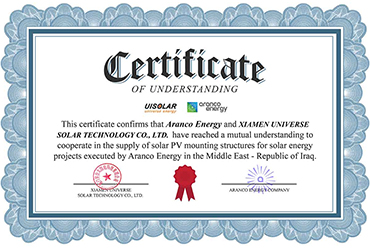
Xiamen Universe Solar Technology Company signed a strategic partnership with Aranco Energy , Iraq. This includes providing and supplying varient solar mounting structures for the commercial projects across Middle East and the Republic of Iraq. Aranco is a leading energy provider in the region, focusing on providing ultimate solutions in electrical and renewable energy fields for the project across Kurdistan and Iraq.
Read More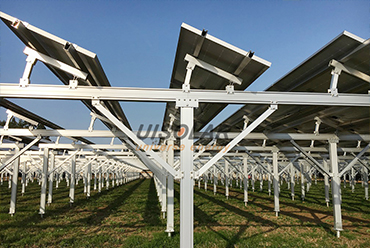
Recently, Namibia officially announced a $1.76 billion strategic plan to expand renewable energy. The plan sets a clear target: by 2030, the country’s installed renewable energy capacity will reach 454 MW, and the share of clean energy in electricity generation will increase from the current 54% to 70%. According to reports, $411 million of the plan’s funding will come from the private sector, while the remaining funds will be sourced through public financing and multilateral cooperation. Namibia’s Minister of Mines and Energy, Natangwe Ithete, pointed out that over half of the country’s electricity currently relies on imports. The high cost of imported power not only drives up tariffs but also strains foreign exchange reserves. “Reducing dependence on external electricity has become a key factor in ensuring national economic stability,” he said. To ensure the plan is implemented, the Namibian government will introduce a series of supporting measures to attract investment. In terms of market mechanisms, the procurement process for independent power producers will be simplified, the single-buyer market scope expanded, and large consumers will be allowed to purchase electricity directly from power plants. On the technology integration side, incentive policies will be introduced for battery energy storage systems to facilitate the efficient integration of renewable energy into the grid. Currently, the country’s first battery storage project is in the design and construction phase, with commercial operation planned for 2026, which will provide experience for future storage projects. It is worth noting that this plan also reflects Namibia’s vision to become a regional power hub. The country plans to build cross-border transmission lines connecting Angola, Botswana, Zambia, and Zimbabwe, strengthening energy security through regional electricity trade. Previously, the Kunene–Omatando substation, constructed by a Chinese company, was officially put into operation. It now serves as a key node connecting Namibia’s power network with neighboring countries, laying the foundation for regional energy integration. Namibia’s ambitious renewable energy strategy presents significant opportunities for global solar industry participants. The construction of large-scale ground-mounted solar farms, distributed projects, and supporting energy storage systems places higher demands on the durability, adaptability, and cost-efficiency of solar mounting systems. As a provider focused on delivering reliable solar mounting solutions, UISOLAR mounting system is committed to offering high-reliability, versatile fixed and tracking mounting products for such large-scale energy projects. We closely follow energy developments in Namibia and the Southern African market, and look forward to supporting more green energy projects with our professional products and services, contributing to the global energy transition. To learn more about how UISOLAR mounting systems can add value to...
Read More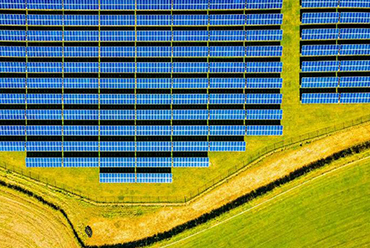
On December 1, the World Bank announced a $6 billion investment to develop the South Johor Renewable Energy Corridor project in Malaysia. The project, with a capacity of 4 GW/5.12 GWh, is being advanced by the International Finance Corporation, Johor’s investment agency PDT, and local energy company Ditrolic Energy. It marks a key milestone in implementing the ASEAN Power Grid initiative. The project plans to deploy large-scale solar and energy storage facilities across an area of approximately 2,000 square kilometers in Johor, focusing on solar resources in the Kota Tinggi and Mersing regions. As a core energy component of the Johor-Singapore Special Economic Zone master plan, the project is set to become a top-tier clean power production hub in Southeast Asia, supplying electricity directly via cross-border transmission systems to power-strapped Singapore. According to data from Singapore’s Energy Market Authority, the country plans to import 6 GW of low-carbon electricity by 2035, accounting for one-third of its energy demand at that time. An IFC representative stated that the project’s low-cost renewable electricity will meet both local business needs in Johor and the energy demands of regional hyperscale data centers and manufacturing industries. This aligns with Johor’s call for high-efficiency energy solutions following its suspension of low-efficiency data centers. As a core node of the ASEAN Power Grid initiative, this project resonates with the recent ASEAN Grid Financing Initiative jointly launched by the Asian Development Bank and the World Bank. Current cross-border interconnection capacity in ASEAN stands at 7.7 GW and is planned to double by 2040, with the South Johor Corridor providing critical support toward this goal. CEO of Ditrolic Energy, Tan Chee Aun, noted that Johor-based enterprises will leverage this corridor to strengthen their clean energy export capabilities, laying a solid foundation for low-carbon transformation in regional industries. Industry analysis suggests that the project’s integrated solar-plus-storage model effectively addresses the intermittency challenges of renewable energy. It not only supports Malaysia’s goal of increasing renewable energy generation by 2030 but also offers Singapore a new pathway for diversifying its energy imports. As the project progresses, regional energy cooperation in Southeast Asia is entering a substantive phase, providing a key demonstration for ASEAN’s $764 billion grid construction plan.
Read More
Universe Solar(UISOLAR) is a high-tech enterprise specializing in the development,manufacturing and marketing of PV mounting. With our top quality and service, UISOLAR mountings are welcomed by most of the installers, distributors, and EPC ect. all over the world.
Please read on, stay posted, subscribe, and we welcome you to tell us what you think.


 online service
 +86 (0592)5663849
 sales@uisolar.com
 solar-mount.au
 English
 français
 Deutsch
 русский
 español
 português
 Nederlands
 العربية
 日本語
日本語 한국의
한국의
 IPv6 network supported